The Complete HIPAA Compliance Process
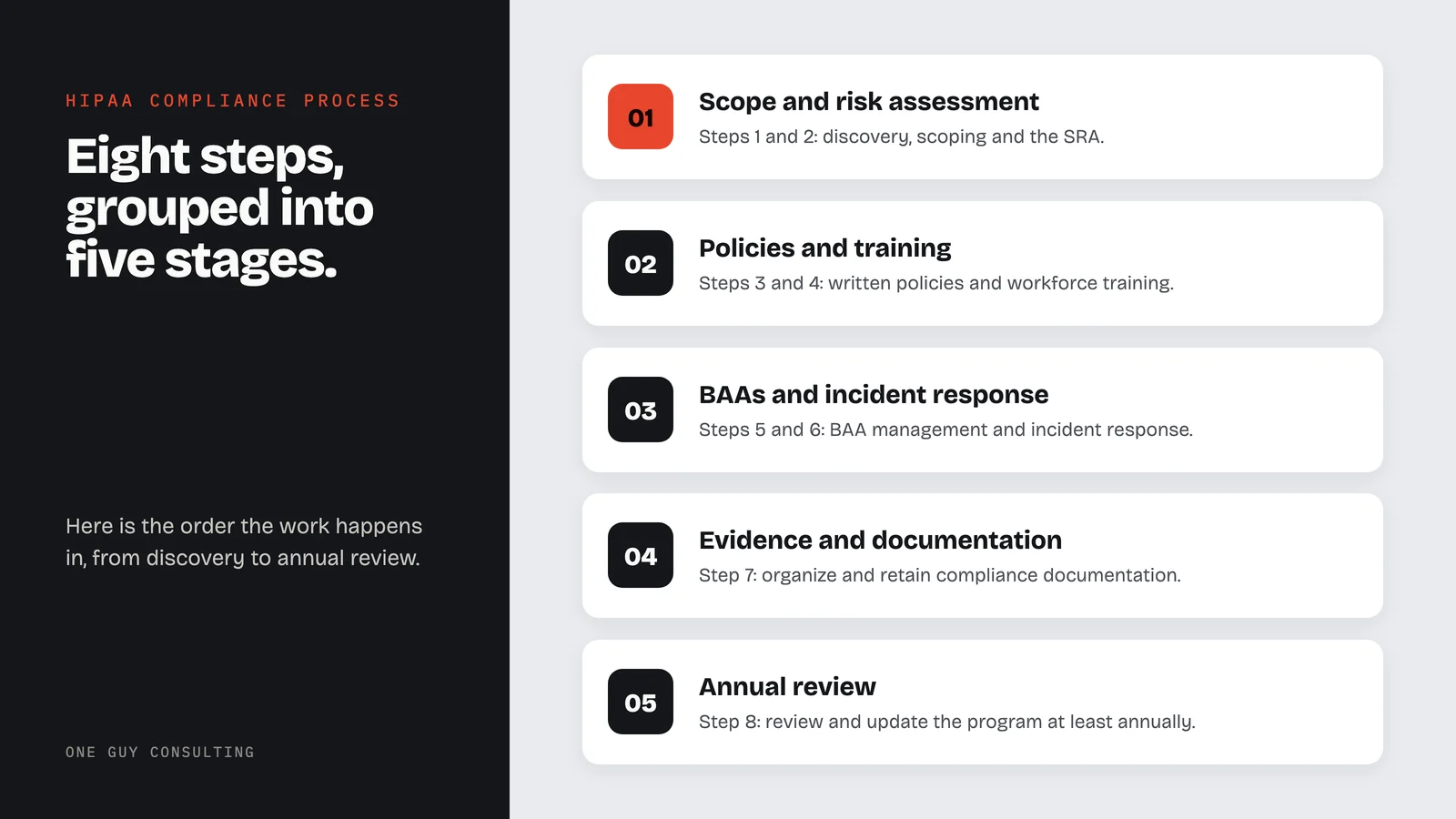
One Guy Consulting's HIPAA process is eight steps from discovery through annual sustainment. Steps 1 to 3: Discovery & Scope Assessment; Security Risk Assessment; Policy & Procedure Development. Steps 4 to 6: Workforce Training; BAA (Business Associate Agreement) Management; Incident Response & Breach Preparedness. Steps 7 to 8: Evidence Packaging & Documentation; Annual Review & Sustainment.
Overview
OCR (HHS Office for Civil Rights) does not just check whether you have individual safeguards in place. They evaluate whether your organization follows a systematic, documented approach to protecting patient information. The Security Rule under 45 CFR 164.306(a) requires covered entities and business associates to ensure the confidentiality, integrity, and availability of all ePHI (electronic protected health information) they create, receive, maintain, or transmit.
A defined process turns compliance from a guessing game into an operational system.
Each step builds on the previous one. Skipping steps or addressing them out of order creates gaps that OCR specifically looks for during investigations.
If you are starting from scratch or unsure where your practice stands, our HIPAA starting point guide covers the first priorities. For a phased checklist approach, see the HIPAA starter checklist.
Eight-Step Process
- 01
Discovery & Scope Assessment
Identify the boundaries of your compliance program: which locations, systems, and workforce members handle PHI. Document your current state against the requirements of 45 CFR 164.306(a). This determines what the remaining seven steps need to cover.
HIPAA gap analysis servicesKey deliverablesPHI inventory, system inventory, workforce roster, scope document. - 02
Security Risk Assessment
Conduct a thorough SRA (Security Risk Assessment) as required by 45 CFR 164.308(a)(1)(ii)(A). Identify every system, device, and workflow that stores, transmits, or accesses ePHI. Document threats and vulnerabilities, rate risk levels, and create a prioritized remediation plan.
The rule reads:
Conduct an accurate and thorough assessment of the potential risks and vulnerabilities to the confidentiality, integrity, and availability of electronic protected health information held by the covered entity or business associate.
(Source: 45 CFR 164.308(a)(1)(ii)(A))OCR runs a Risk Analysis Initiative focused on this requirement, and its 2016-2017 audits found most audited organizations had not met it. See how the gap analysis and remediation plan are built from the SRA.
Security Risk Assessment requirements and processKey deliverablesCompleted SRA report, risk register, remediation plan with timelines. - 03
Policy & Procedure Development
Develop written policies and procedures that comply with the Security Rule as required by 45 CFR 164.316(a). Policies must reflect how your practice actually operates, not how a generic template assumes you operate. At minimum, cover privacy, security management, access control, training, device controls, incident response, BAA management, facility access, contingency planning, and sanctions.
HIPAA policy templates for small practicesKey deliverablesCustomized policy manual, procedure documents, adoption records. - 04
Workforce Training
Train every workforce member who handles PHI, as required by 45 CFR 164.308(a)(5)(i); new members within a reasonable period after joining (45 CFR 164.530(b)(2)(i)(B)). Training must cover the Privacy Rule, Security Rule, breach reporting, phishing awareness, and your practice-specific policies. Document completion with signed attestations and schedule annual refresher training.
HIPAA training requirements and program detailsKey deliverablesTraining curriculum, completion records, signed attestations, refresher schedule. - 05
BAA Management
Identify every vendor and subcontractor that creates, receives, maintains, or transmits PHI on your behalf. Execute Business Associate Agreements as required by 45 CFR 164.502(e) and 164.308(b)(1). Maintain a current BAA inventory and review vendor compliance annually.
BAA management and vendor complianceKey deliverablesVendor inventory, executed BAAs, annual review schedule. - 06
Incident Response & Breach Preparedness
Establish an incident response plan covering breach identification, containment, risk assessment, notification timelines, and documentation. Meet the notification requirements of 45 CFR 164.404(b), 164.406, and 164.408. Conduct tabletop exercises so your team knows what to do before a breach occurs.
The rule reads:
Incident response and breach managementExcept as provided in § 164.412, a covered entity shall provide the notification required by paragraph (a) of this section without unreasonable delay and in no case later than 60 calendar days after discovery of a breach.
(Source: 45 CFR 164.404(b))Key deliverablesIncident response plan, notification procedures, tabletop exercise records. - 07
Evidence Packaging & Documentation
Organize and retain all compliance documentation for at least six years as required by 45 CFR 164.530(j). This includes your completed SRA, written policies, training records, BAA inventory, incident reports, and remediation evidence. If OCR investigates, this documentation is your evidence of a systematic compliance effort.
The rule reads:
Documentation requirements and starting pointA covered entity must retain the documentation required by paragraph (j)(1) of this section for six years from the date of its creation or the date when it last was in effect, whichever is later.
(Source: 45 CFR 164.530(j)(2))Key deliverablesOrganized compliance binder, document retention schedule, evidence index. - 08
Annual Review & Sustainment
Review and update your entire compliance program on a regular schedule; once a year is a common cadence. HIPAA itself calls for a periodic evaluation (45 CFR 164.308(a)(8)) and periodic review of documentation (164.316(b)(2)(iii)), and again after environmental or operational changes. Reassess risks when systems or workflows change, update policies accordingly, retrain staff, verify BAA currency, and test your incident response plan. Compliance is not a one-time project.
Vendor management and annual review servicesKey deliverablesAnnual review report, updated SRA, policy revision log, training refresher records.
Timeline & Deliverables
For a small practice with 1 to 25 staff members, the initial compliance process takes weeks, not months, when working with a consultant. Here is the order the work happens in:
Steps 1 & 2
Discovery, scoping, and Security Risk Assessment
Steps 3 & 4
Policy development and workforce training
Steps 5 & 6
BAA management and incident response planning
Step 7
Evidence packaging and documentation organization
Step 8
Annual review and continuous sustainment
| Step | What it covers | Rule | Key deliverables |
|---|---|---|---|
| 1 | Discovery & Scope Assessment | 45 CFR 164.306(a) | PHI inventory, system inventory, workforce roster, scope document |
| 2 | Security Risk Assessment | 45 CFR 164.308(a)(1)(ii)(A) | Completed SRA report, risk register, remediation plan with timelines |
| 3 | Policy & Procedure Development | 45 CFR 164.316(a) | Customized policy manual, procedure documents, adoption records |
| 4 | Workforce Training | 45 CFR 164.308(a)(5)(i) | Training curriculum, completion records, signed attestations, refresher schedule |
| 5 | BAA Management | 45 CFR 164.502(e) | Vendor inventory, executed BAAs, annual review schedule |
| 6 | Incident Response & Breach Preparedness | 45 CFR 164.404(b) | Incident response plan, notification procedures, tabletop exercise records |
| 7 | Evidence Packaging & Documentation | 45 CFR 164.530(j) | Organized compliance binder, document retention schedule, evidence index |
| 8 | Annual Review & Sustainment | 45 CFR 164.308(a)(8) | Annual review report, updated SRA, policy revision log, training refresher records |
Timelines vary based on practice size, complexity, and existing documentation. Larger organizations or those with multiple locations may need additional time.
Results from real engagements
Three anonymized before-and-after results from the case studies page, each from work Chuck did directly:
| Case | Practice | Before | After |
|---|---|---|---|
| Case 01 | Mental health office, Florida | Policies never written, records with holes, staff training half done, and a state auditor due in days | Audit-ready in under a week; passed its state audit and kept seeing patients |
| Case 03 | Health group, 100+ offices | Offices had gone quiet on the program; take-up lagged despite auto-emails and reminders | Program take-up rose about 17% after office-by-office outreach; more staff finished required training |
| Case 05 | Single-location practice | Several vendors handling protected health information with no Business Associate Agreement | Every missing BAA signed, vendor files sorted, and a written vendor review the practice can run again |
One Guy Consulting in 37 seconds
One Plan to Work Through This
One plan, three ways to pay. No per-user fees.
Chuck walks you through every step. Includes your SRA, custom policies, staff training, BAA review, and ongoing support, with 4 hours a month of 1:1 implementation calls with Chuck.
View Plan DetailsSecure checkout by Stripe. Your payment details go straight to Stripe and never touch our servers.
HIPAA Compliance Process FAQ
What are the steps to HIPAA compliance?+
How long does HIPAA compliance take?+
What is the first step toward HIPAA compliance?+
Can a small practice achieve HIPAA compliance without a consultant?+
Ready to Start Your Compliance Journey?
One Guy Consulting works directly with small practices to build HIPAA compliance programs from scratch. Chuck walks you through every step.
Learn More About HIPAA Compliance
Explore Our Other HIPAA Services
This content is for educational and informational purposes only and should not be construed as legal advice.