Close Compliance Gaps with a HIPAA Remediation Plan
A gap analysis identifies what needs fixing. A remediation plan defines how to fix it, who owns each task, and when it gets done. It is the structured, prioritized action plan that auditors expect to see.
What Is a HIPAA Remediation Plan?
A HIPAA remediation plan is a structured, prioritized action plan that addresses compliance gaps identified during a Security Risk Assessment or gap analysis. Each item specifies an owner, a deadline, and evidence of completion, as required by 45 CFR 164.308(a)(1)(ii)(B). Our gap analysis and remediation plan guide shows how the two documents connect.
A fix plan closes the gaps found in your assessment. Each item gets one owner, one due date, and a clear test for "done."
Required under 45 CFR §164.308(a)(1)(ii)(B), a remediation plan is proof that you are fixing risks, not just listing them.
In the One Guy Consulting portal, your plan builds itself from your Security Risk Assessment answers. The moment gaps become visible, you have marching orders.
OCR checks that you found your risks and acted on them. A fix plan is that proof.
Who Needs This
- Organizations that completed an SRA or gap analysis but lack a formal fix plan
- Teams preparing for audits who need documented corrective action evidence
- Practices that keep rediscovering the same compliance gaps year after year
- Groups with findings from consultants or assessors that never got actioned
- Business associates whose clients require proof of active risk management
What Happens After Your Risk Assessment
This is the exact path from assessment to fix plan inside the One Guy Consulting portal. You answer the questions, the system builds the plan, and we work it together. It covers step 2 of the eight-step HIPAA compliance process; policies, training, and BAAs follow.
Here is Every Step:
1. Start with the Security Risk Assessment
The Security Risk Assessment explains when to mark Yes, when to mark No, and what to do when you finish. Only answer Yes when you can back it with written evidence. No is a perfectly fine answer. If this is your first HIPAA compliance plan, you probably lack a fair amount of what is required, and that is fine. The goal is to learn where you stand. Anything you lack, we develop together.
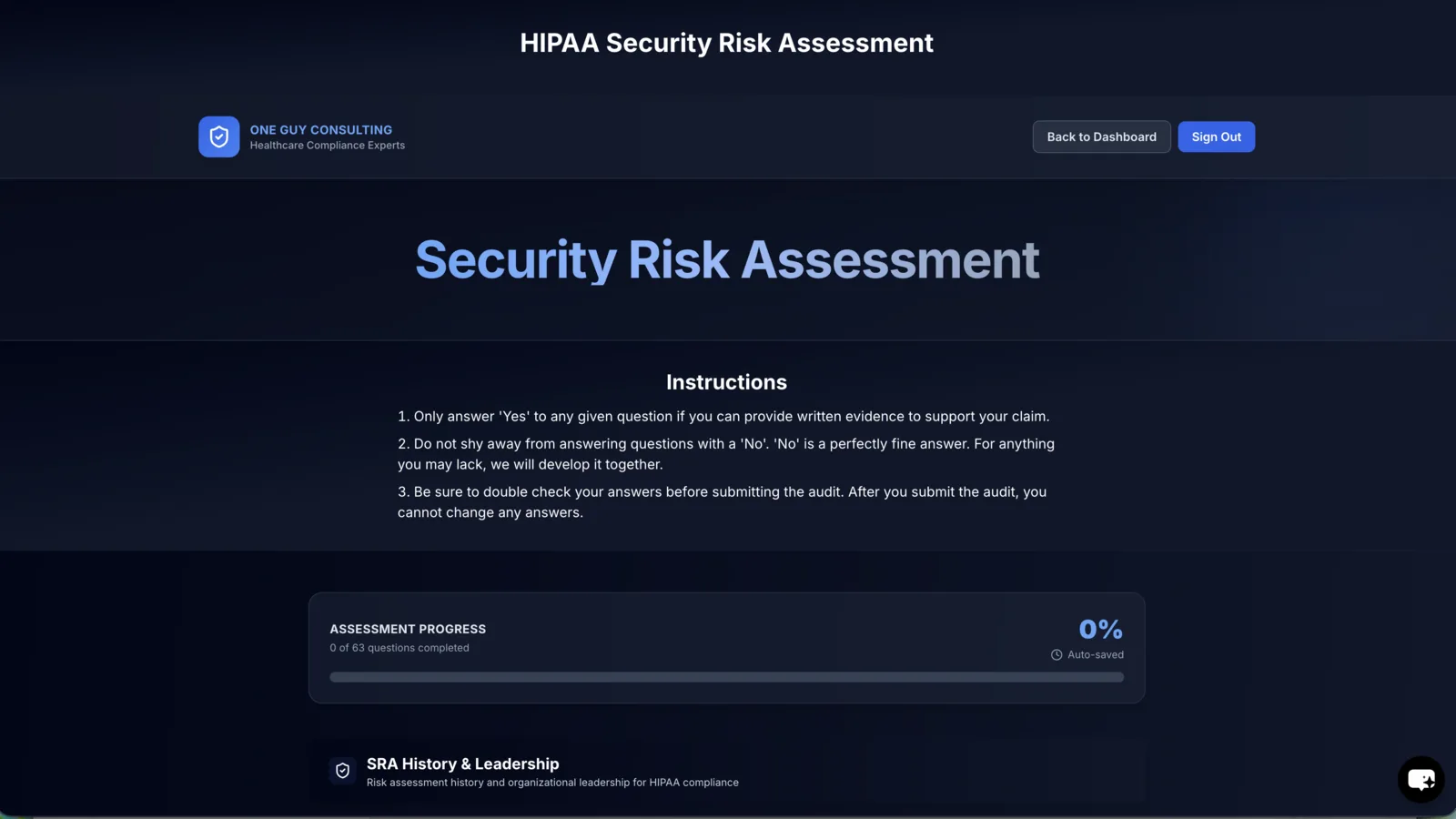
2. Your answers lock when you submit
You work through the questions at your own pace, and nothing locks until the very end. Double check everything before you press Complete, because after you submit the audit you cannot change any answers. That lock matters: your gap analysis reads from one clean snapshot in time. As soon as you finish, export a copy of your results for your records.

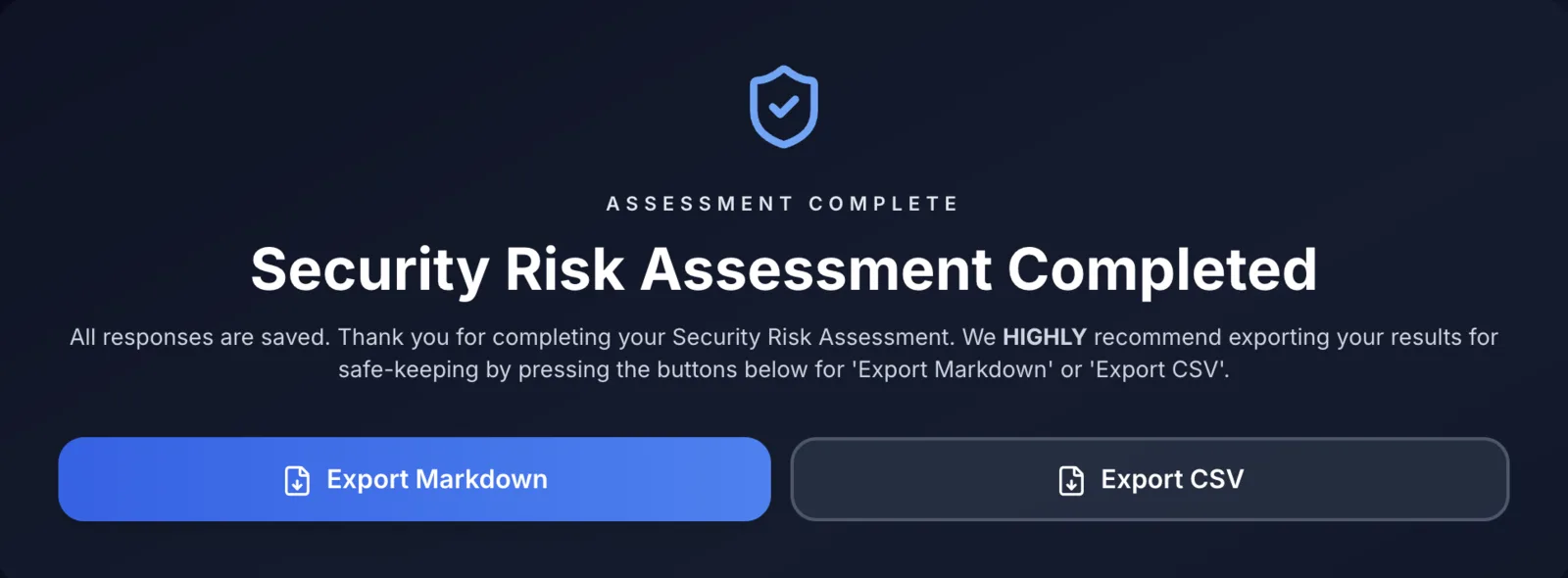
3. Your gap analysis generates automatically
Finish the 63 questions in the current Security Risk Assessment and your gap analysis generates automatically. A dashboard summary is ready the moment you submit. Hit Export Gap Report in the bottom right and you are holding your first piece of audit evidence.
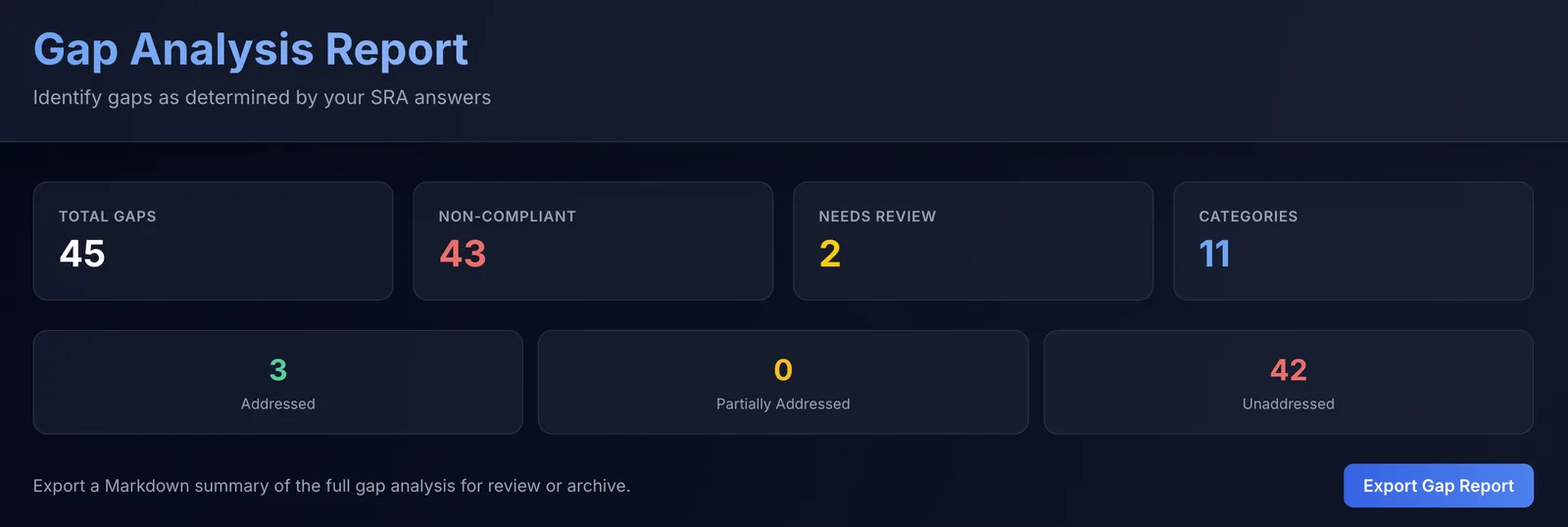
4. Your remediation plans generate too
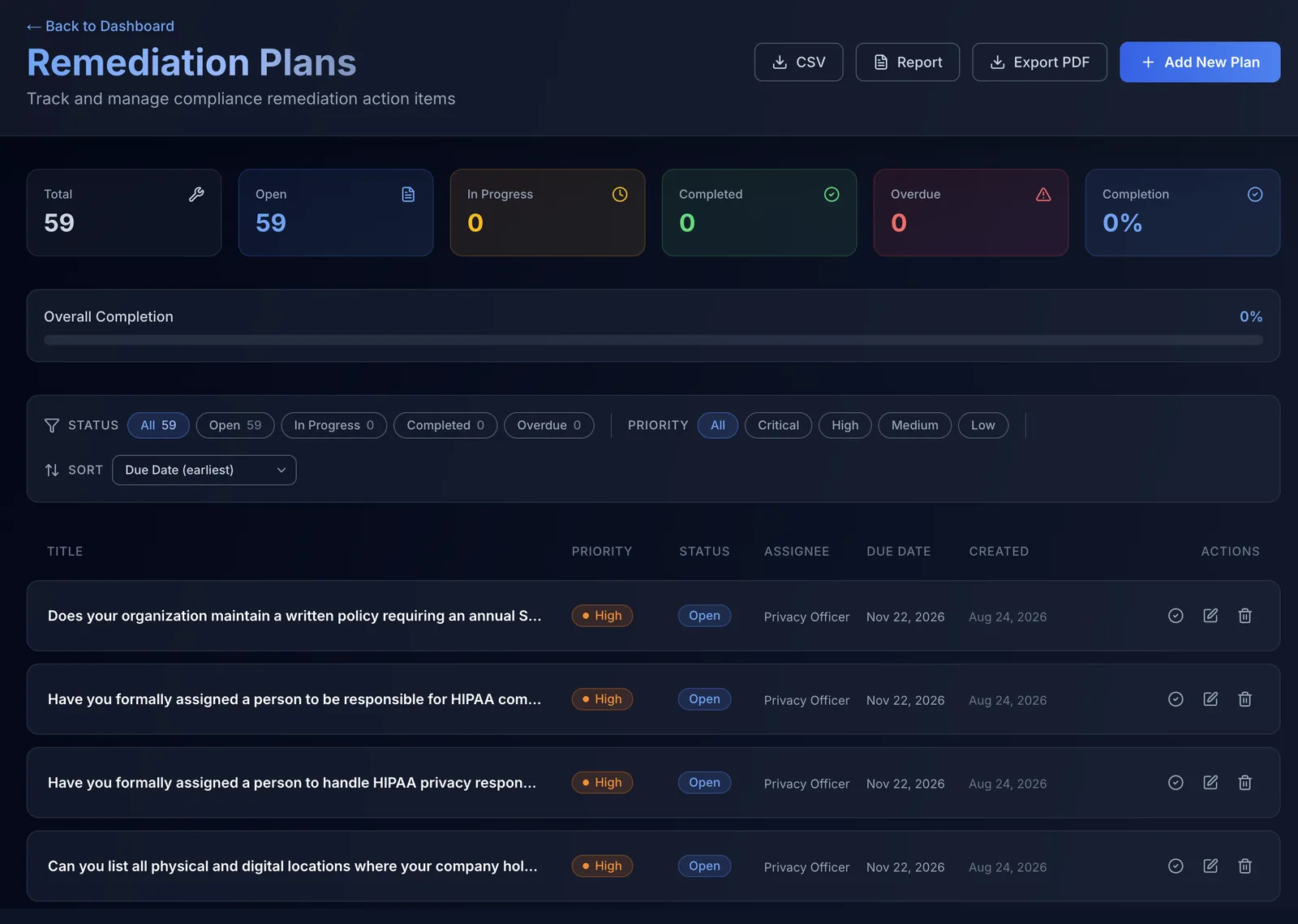
Here is the part clients like best. Remediation plans generate as soon as gaps become visible to the tool, based on your answers and the patterns behind them. The description IS your plan: it tells you exactly what to do in plain English. Priority is set automatically, and your Privacy Officer can amend it. The same window shows who is responsible, when it is due, notes from the assignee, and any supporting documents attached as proof. When the work is done, save or close the plan from the bottom. Super easy.
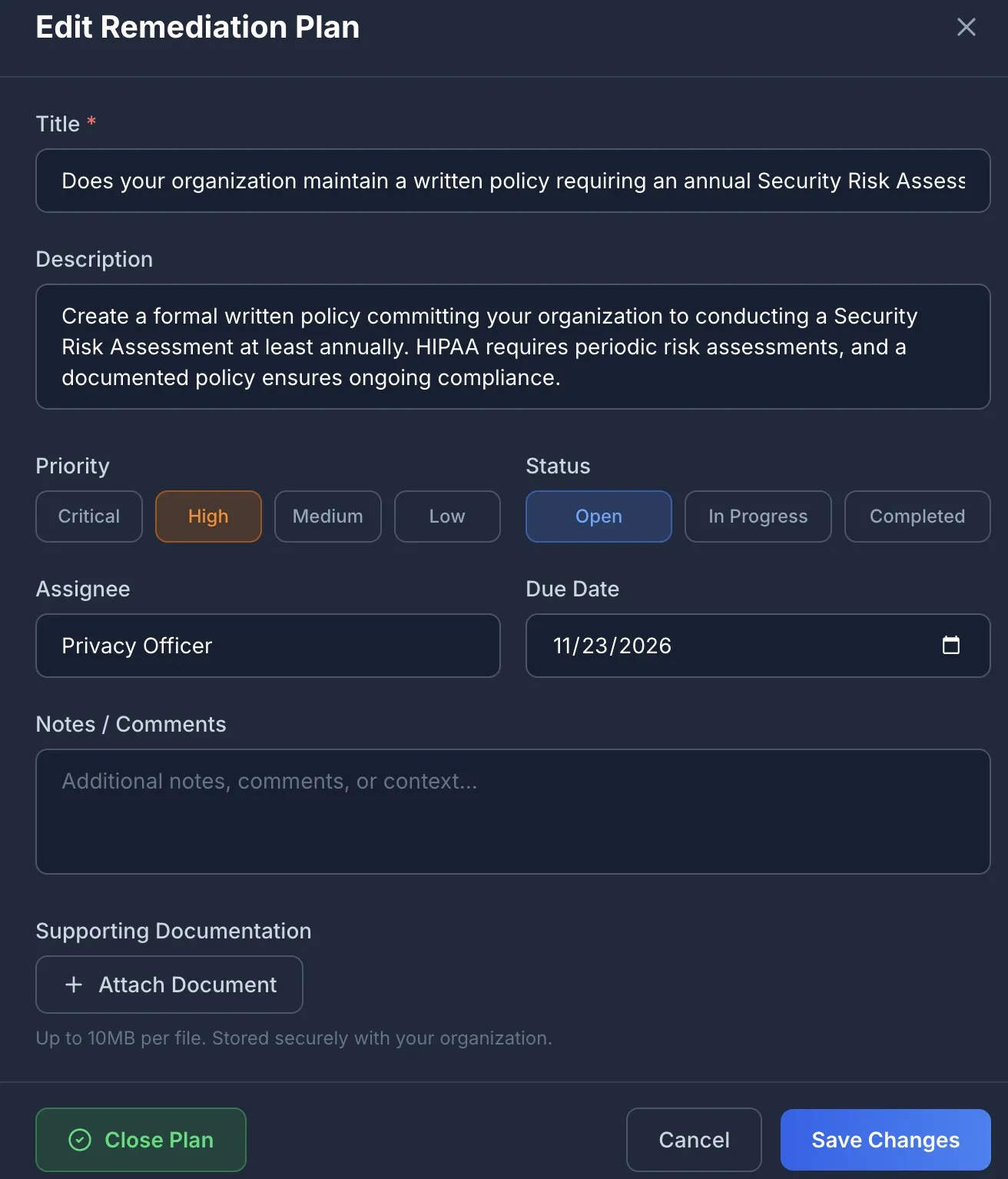
5. Track everything on one dashboard
The Remediation Plan Dashboard is the running summary of this part of your compliance plan. Filter by status or priority, sort by due date, and export to CSV or PDF when a client or auditor asks for proof. And you are not working the list alone: we walk through it together in your implementation meetings until every item is closed.
Remediation Progress & Priority Benchmarks
Common patterns we see before structured planning. Your results will match your setup.
Remediation by Category
How fix tasks break down by control area
CATEGORIES
Remediation Completion Rates
How fast items close by plan type and priority
Gap Closure: Before vs. After
Typical gap closure rate with and without a structured plan
Typical 90-day remediation result
Remediation Plan Case Study
Scenario
A multi-provider practice finished their yearly risk assessment and gap analysis. They had 47 findings across policy, tech, and admin areas. No one knew who owned which fix or when it was due.
Key Gaps Found
No formal tracking. Last year's findings came back. Big issues like missing encryption and failed access reviews had no owners or due dates.
Result
Within 90 days, 38 of 47 items were closed with documented evidence. The remaining 9 had approved timelines and active owners. Leadership had a single dashboard view of compliance progress.
Implementation Timeline
Most plans are up and running in two weeks. Monthly tracking goes on until every item is closed with proof.
- Finding consolidation & severity review
- Stakeholder alignment
- Ownership model design
- Priority matrix build
- Task-level breakdown
- Evidence requirements defined
- Owner assignments & kickoff
- Implementation tracking begins
- Weekly progress reviews
- Monthly status reviews
- Evidence collection & archival
- Plan updates for new findings
Remediation Patterns by Healthcare Specialty
Priorities depend on your specialty. Plans match how your type of practice works day to day.
Medical Practices
Multiple teams with busy clinical schedules and shared systems that all need fixes.
Behavioral Health
Fixing sensitive records while keeping strict privacy and consent rules.
Dental Practices
X-ray system updates, workstation fixes, and better front-desk access controls.
Pharmacies
Drug workflow access rules, POS system locks, and tighter system links.
Business Associates
Fix timelines tied to contracts, client reports, and BAA proof.
What Your Remediation Plan Includes
You do not build this plan by hand. Your remediation plan is generated automatically from your Security Risk Assessment answers, mapped against current best practice for maintaining HIPAA compliance. You see what is wrong and how to fix it the right way, on the spot.
Prioritized Remediation Register
Every finding ranked by risk with an owner, a due date, and what proof is needed.
Implementation Roadmap
A timeline that shows what gets fixed first for the biggest impact.
Progress Dashboard
A monthly view of what is done, what is late, and how strong the proof is.
Evidence Collection Guide
Clear rules for what counts as proof that a fix is done.
Audit-Ready Documentation
Clean records that show auditors you are fixing problems, not just listing them.
Why Structured Remediation Delivers Better Outcomes
Most programs stall between finding problems and fixing them. A structured plan makes every task specific, owned, and tracked.
When auditors ask what you did about a finding, you show the plan, the proof, and the closure record.
Structured plans also cut costs. Teams fix things on a set schedule instead of scrambling before audits.
Organizations that plan fixes stop seeing the same problems come back year after year.
Common Remediation Pitfalls
- Unowned findings: Remediation items without specific owners stall indefinitely
- Missing deadlines: Plans without due dates become wishlists that never get executed
- No evidence standards: Completing a fix without proof is the same as not completing it for audit purposes
- One-time effort: Remediation plans need ongoing updates as new findings emerge and controls evolve
- Template-only plans: Generic action items that do not reflect your actual workflows, systems, or staffing
How to Track Remediation Progress
Track four monthly numbers: how many findings are closed by severity, proof quality, overdue count, and how often items reopen.
These four numbers indicate whether a program is moving forward or stalling.
Watch rework closely. When the same findings keep reopening or proof is weak, it usually means the team does not know what "done" looks like.
Leaders need to see trends, not just snapshots. Teams fix things faster when leaders can tell if progress is going up or down.
Organizations with structured remediation plans typically close identified compliance gaps significantly faster than those that review gaps only at year-end.
OCR expects to see evidence of both risk identification AND corrective action. A risk assessment that identifies gaps but has no remediation plan is itself a compliance deficiency.
Deep-Dive Resources
These guides cover the full path from assessment to remediation:
Key Terms
- Remediation Plan
- A documented, prioritized list of corrective actions that address findings from a Security Risk Analysis or gap analysis, each with an assigned owner, deadline, and evidence requirement.
- Corrective Action Plan (CAP)
- A formal response to audit findings or enforcement actions required by the HHS Office for Civil Rights (OCR). CAPs typically include specific milestones, monitoring periods, and reporting obligations.
- Gap Analysis
- An evaluation that identifies the differences between an organization's current HIPAA compliance posture and the requirements of the Security Rule (45 CFR Part 164, Subpart C).
- Evidence of Remediation
- Documentation that demonstrates a corrective action was completed, such as updated policies, system configuration screenshots, training completion records, or access control logs.
- Risk Severity
- A classification (critical, high, medium, low) based on the likelihood and impact of a vulnerability being exploited, used to prioritize remediation sequencing per NIST SP 800-30 methodology.
- Plan of Action and Milestones (POA&M)
- A project management document used in federal compliance frameworks that tracks specific weaknesses, planned corrective actions, responsible parties, and scheduled completion dates.
Frequently Asked Questions
Chuck Weiselberg, Certified HIPAA Professional (C.H.P.). Zero client fines. Zero failed audits.
“One Guy Consulting is super easy to work with. I actually look forward to my implementation meetings for HIPAA.” – Samantha M.
Start With a Conversation
We review your current findings, build a ranked fix plan, and set up tracking so nothing falls through the cracks.
Book Your Free 30 Minute HIPAA Compliance Review